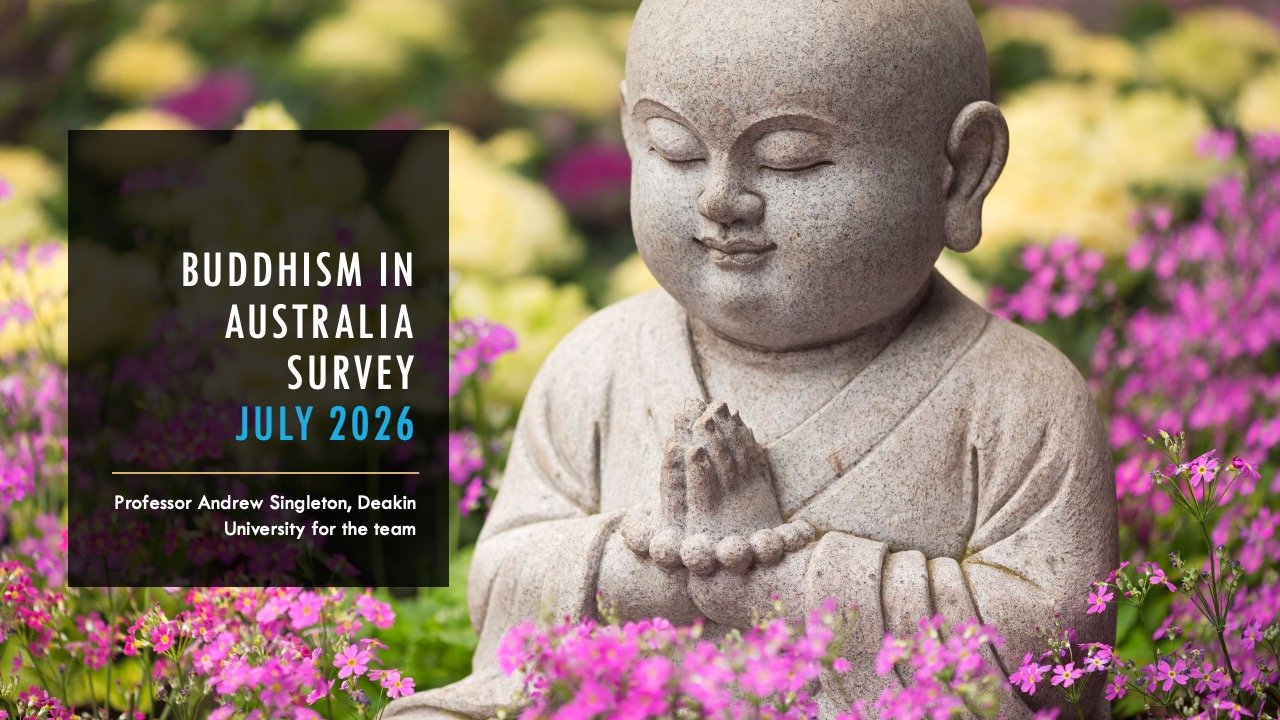
What does it mean to be Buddhist in Australia today? Preliminary findings from the Buddhism in Australia Survey offer one of the clearest pictures yet of Australia’s Buddhist communities.
Presented by Professor Andrew Singleton at an NTI Conversations seminar on 29 July 2026, the survey found a striking level of agreement on core Buddhist teachings across traditions, while also highlighting the many ways Buddhists practise their faith. Nearly three-quarters of respondents described Buddhism as a guiding philosophy or worldview, and around two-thirds regarded it as both their faith and a source of meaning and purpose.
Conducted between September 2025 and June 2026 in seven community languages, the survey received 2,317 completed responses from adults living in Australia who identify as Buddhists or embrace Buddhist ideas and values. Participants were recruited through temples, Buddhist organisations, events, and social media.
The findings also reflect the close relationship between Buddhism and migration. While 73% of respondents were born overseas, most reported a strong sense of belonging in Australia. The survey further showed that Buddhist communities are both locally rooted and globally connected: 87% had participated in a Buddhist temple, centre, or organisation during the previous year, with many also engaging through overseas organisations, online platforms, and informal networks.
The survey forms part of the three-year research project Buddhism in Australia: Belonging, Wellbeing and Social Engagement, led by Nan Tien Institute, Deakin University, Western Sydney University, and Charles Darwin University, with support from the Hsing Yun Education Foundation.
A more detailed Project Report will be launched at Nan Tien Institute on 22 September 2026, with additional findings to be explored in forthcoming academic publications.